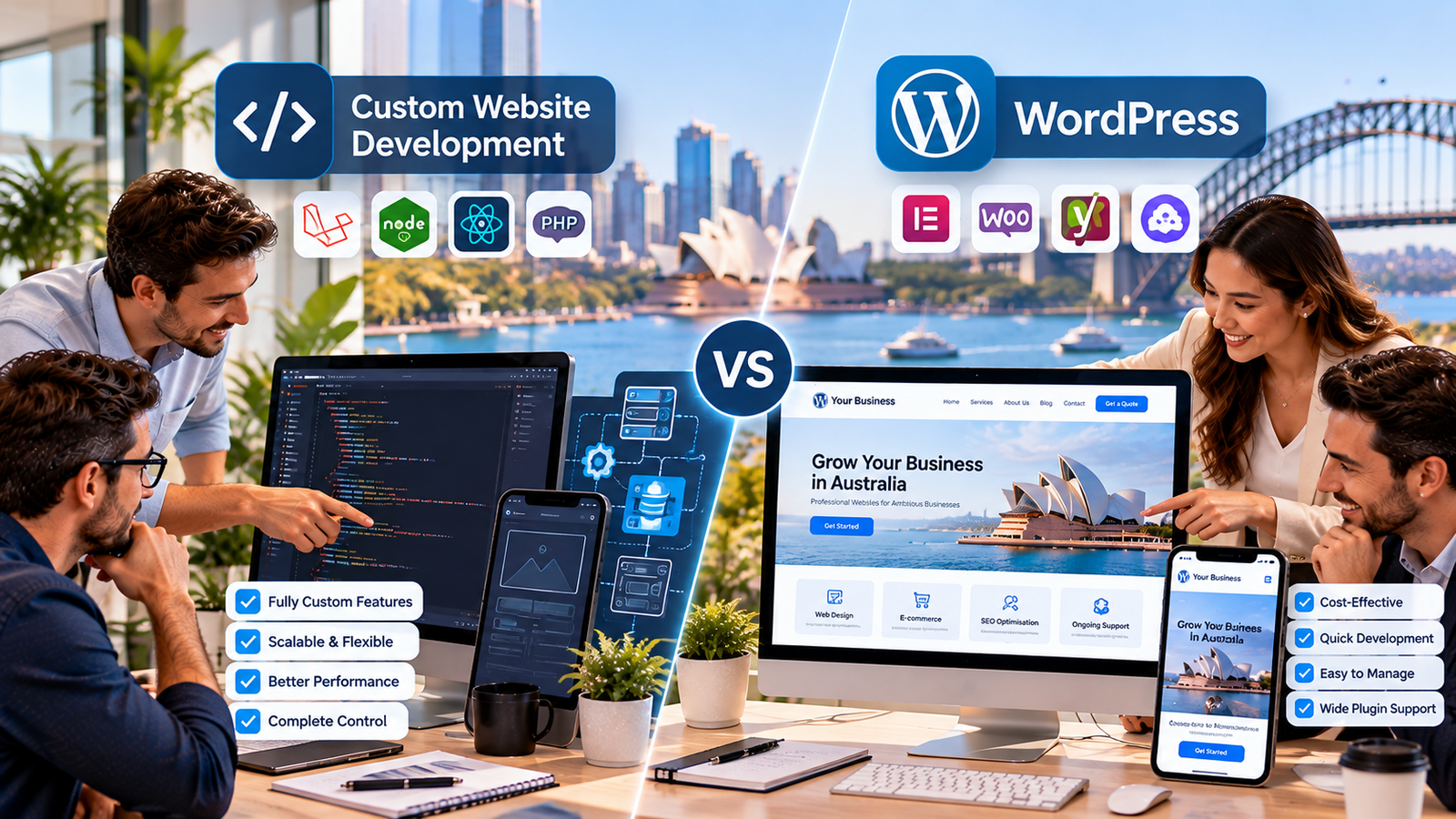
An owner in Melbourne gets two quotes for the same website. One is for WordPress. The other is for a fully custom build at several times the price. Both agencies sound confident, both say theirs is the better choice, and neither explains why in terms the owner can use.
This guide settles the custom website development vs WordPress question with a practical framework. You’ll see where each option wins, how Australian requirements such as accessibility, privacy, GST and local payment methods affect the choice, the mistakes that make either route expensive, and a checklist to decide for your own business. Rajhans Digital builds both, so there’s no reason here to push one over the other.
The Short Answer
For most small and medium Australian businesses with standard needs (a brochure site, services, lead forms, a blog, even a typical online shop), WordPress is the sensible default. It’s mature, widely supported and cheaper to start. Custom development earns its cost when your website is really a software product, or when your requirements are too specific, too complex or too sensitive for a plugin-based approach.
The honest middle path is common too: WordPress for content and marketing pages, with custom code or a separate application for the one function that needs it.
What Each Option Actually Means
WordPress is open-source content management software. You choose a theme, add plugins for features, and write custom code where needed. Its reach is hard to ignore: W3Techs data shows WordPress running roughly four in ten websites worldwide, which means a large talent pool, extensive documentation and many ready-made integrations.
Custom website development means building the site’s structure and features from scratch, usually with a framework such as Laravel, Node.js or a headless setup, and often with a purpose-built admin area. Nothing is inherited from a CMS, so everything you get is something someone designed and wrote for you.
Neither is automatically better, faster, more secure or more search-friendly. The right one depends on what the site has to do.
Custom Website Development vs WordPress: Side-by-Side Comparison
| Factor | WordPress | Custom development |
|---|---|---|
| Upfront cost | Usually lower for standard sites | Usually higher, since everything is built to order |
| Time to launch | Often faster, thanks to themes and plugins | Longer, because design, logic and admin are built from scratch |
| Flexibility | High, but constrained by plugin quality | Very high, built exactly to your process |
| Content editing | Familiar editor, easy for non-technical staff | Depends entirely on the admin interface built for you |
| Security | Core is maintained, but plugins add risk | No plugin ecosystem, but security depends on the developer’s practices |
| Performance | Fast if well built, slow if overloaded with plugins | Can be very lean, if the developer does it properly |
| SEO | Mature tooling and flexible structure | Everything must be built in (meta tags, sitemaps, redirects, schema) |
| Maintenance | Regular core, theme and plugin updates | Framework updates and developer-dependent fixes |
| Developer availability | Large pool, easier to switch providers | Smaller pool, tied to whoever knows your codebase |
| Scaling complex logic | Harder beyond a point | Designed for it |
Read this table as a set of trade-offs, not a scoreboard. Security is a good example: WordPress core is actively maintained, but outdated plugins are a common way sites get compromised. A custom site avoids that ecosystem but puts the full security burden on the developer’s code and your maintenance plan.
When WordPress Is the Better Choice
WordPress usually wins when:
- Your site is mostly content. Service pages, case studies, a blog, team profiles and contact forms are what WordPress does well.
- Your team needs to edit it themselves. Marketing staff can update pages without a developer.
- You want to launch in weeks. Established themes and plugins shorten delivery.
- Budget matters. A Brisbane electrician or a Perth physiotherapy clinic needs a credible, fast, easy-to-update site, not a software platform.
- You want flexibility to change providers later. Because so many developers know WordPress, you aren’t locked in.
- You’ll add features gradually. Bookings, memberships, WooCommerce and CRM integrations are available when you need them.
If you’re leaning this way, see our WordPress development and website services.
When Custom Development Is the Better Choice
A custom build usually wins when:
- The website is the product. A Sydney SaaS startup with user accounts, subscriptions and dashboards needs an application, not a CMS.
- Your business logic is unusual. Complex pricing rules, multi-step workflows or role-based permissions strain plugin-based solutions.
- You need deep integration. Connecting to a practice-management system, ERP or proprietary database may call for custom APIs.
- You expect heavy, specialised scale or performance demands.
- Compliance or data handling needs tight control. Regulated or sensitive data sometimes justifies tailored architecture.
- You’ve outgrown a plugin stack. If twenty plugins are held together with workarounds, a rebuild may cost less than endless patching.
Custom doesn’t mean “premium”. A custom site built without clear requirements, documentation or SEO foundations can be more expensive and less capable than a well-built WordPress site.
The Hybrid Option Many Businesses Overlook
You don’t have to choose one for everything. Practical combinations include:
- WordPress marketing site plus a custom web application at a subdomain (for example,
app.yourbusiness.com.au) - WordPress with custom plugins for one specific function, such as a quote calculator or booking rule
- Headless WordPress, where WordPress manages content and a custom front end displays it. It suits teams with strong developer capacity, but it adds complexity.
A hybrid keeps content editing simple while giving you custom power where it matters.
Australian Factors That Affect the Decision
Accessibility
Australia’s Disability Discrimination Act applies to goods and services provided online. The Australian Human Rights Commission’s 2025 guidelines on equal access to digital goods and services recommend WCAG 2.2 Level AA as the benchmark. The guidance isn’t a statute, but it’s the reference point if someone makes a complaint, and it’s increasingly expected in tenders. The Commission publishes guidance for businesses, and the W3C’s WCAG overview explains the standard.
Both options can be accessible, and both can fail. WordPress themes and page builders vary in quality, and a custom site is only accessible if someone deliberately builds it that way. Ask any developer how they test, and be sceptical of anyone who claims an overlay widget fixes everything.
Privacy
Many Australian businesses have obligations under the Privacy Act, depending on turnover and the type of information they handle. Small businesses under a turnover threshold are often exempt, but exceptions exist, such as health service providers. Rules have been changing, so check with the Office of the Australian Information Commissioner or a lawyer. Either platform needs a clear privacy policy, secure forms, consent-aware tracking and sensible data retention. This is general information, not legal advice.
Payments, GST and Local Expectations
Australian customers often expect card, PayPal and buy-now-pay-later options at checkout. Prices to consumers are generally shown GST-inclusive. WooCommerce and most custom builds can handle all of this, but confirm that your chosen payment providers and tax settings suit your business before you commit.
Local Search
If you serve a city or region, you’ll want service pages, accurate Google Business Profile information and technical SEO from day one. WordPress has mature tools for this. On a custom build, make sure title tags, sitemaps, redirects and structured data are in the scope, because they won’t exist unless someone writes them. Our SEO services and on-page SEO guide cover this.
A Simple Decision Checklist
Answer these honestly. The balance of answers points toward a choice.
- Is most of the site content (pages, posts, forms) rather than application logic? WordPress.
- Do non-technical staff need to update it regularly? WordPress.
- Do users log in to do complex, role-based tasks? Custom.
- Does your pricing or workflow need rules plugins can’t express? Custom, or WordPress with custom plugins.
- Do you need to launch within weeks? WordPress.
- Does it need to connect deeply with internal systems? Custom, or hybrid.
- Is the budget limited, with room to grow later? WordPress.
- Would you want to switch developers easily in future? WordPress.
If your answers split, a hybrid is worth discussing. If you’re unsure which way yours lean, Rajhans Digital can review your requirements and explain the options. You can request a website consultation and we’ll tell you honestly if WordPress is enough.
What It Costs: Factors, Not Fixed Prices
Prices vary too widely to quote responsibly. These are the drivers that move the cost of either route:
| Driver | Effect |
|---|---|
| Number of pages and templates | More unique layouts mean more design and build time |
| Design approach | Fully custom design costs more than an adapted theme |
| Features and integrations | Booking, portals, payments, CRM and API work add effort |
| Content migration | Moving many pages or products takes time |
| Accessibility testing | Thorough testing adds hours |
| Ongoing maintenance | Updates, backups and support are a recurring cost for both routes |
Ask for total cost of ownership over two to three years, not only the build price. A cheap build with high ongoing patching costs can end up dearer than a well-planned alternative.
Seven Costly Mistakes When Choosing Between Custom and WordPress
- Choosing by price alone. The lowest quote often leaves out testing, SEO setup or support.
- Choosing custom because it sounds premium. If your needs are standard, you may pay more for less.
- Choosing WordPress and stacking plugins for everything. Overlapping plugins slow the site and create conflicts.
- Not owning your code. With custom work, insist on source code and repository ownership in the contract.
- Forgetting SEO in a custom build. Without planned redirects, sitemaps and metadata, a rebuild can erase search visibility.
- Ignoring maintenance. Both routes need ongoing care. An unmaintained WordPress site gets compromised, and an unmaintained custom site breaks when a framework or server version changes.
- Skipping a written scope. Vague requirements cause disputes on either path.
How to Choose a Development Partner
- They ask about goals, users and processes before recommending a platform.
- They explain trade-offs, including reasons not to choose their preferred option.
- The proposal lists deliverables, exclusions, testing and handover.
- They use a staging site and can describe how they handle security and backups.
- You own the domain, hosting, admin access and (for custom work) the source code.
- They show real, verifiable work. Be cautious of vague “success stories”.
- They don’t guarantee Google rankings.
Working With a Remote Team
Rajhans Digital works with Australian businesses remotely from India. Sydney and Melbourne are roughly 4.5 to 5.5 hours ahead of us depending on daylight saving, and Perth is about 2.5 hours ahead, so working hours overlap well for calls and reviews. If you want regular in-person workshops at your office, a local agency may suit you better.
Frequently Asked Questions
Is WordPress good enough for a business website in Australia?
For most service businesses, brochure sites, blogs and standard online shops, yes. Problems usually come from poor setup, cheap hosting, pirated themes or neglected updates, not the platform.
Is a custom website more secure than WordPress?
Not automatically. WordPress sites are often compromised through outdated plugins, while custom sites depend on the quality of the developer’s code and ongoing maintenance. Either route needs updates, backups, access control and monitoring.
Which is better for SEO, custom or WordPress?
Neither is inherently better. WordPress provides mature SEO tooling out of the box, while a custom site can match it only if titles, sitemaps, redirects and structured data are built in. Rankings still depend on content quality, speed, authority and competition, and nobody can guarantee them.
How much more does a custom website cost than WordPress?
It depends on scope, but custom builds typically cost more upfront because everything is built from scratch. Compare quotes on total cost of ownership, including maintenance, hosting and future changes.
Can I start with WordPress and move to custom later?
Yes. Many businesses launch on WordPress and later build a custom application for specific functions. Keep your content well structured and your data exportable so migration stays manageable.
Do I need an Australian developer?
Not necessarily. Many Australian businesses work with remote teams successfully. What matters is that the team understands local requirements, communicates clearly and delivers a documented, maintainable result.
Conclusion
The custom website development vs WordPress decision comes down to what your website has to do. If it mainly presents your business, collects enquiries and publishes content, WordPress is usually the practical choice. If it runs complex logic, serves logged-in users or integrates deeply with other systems, a custom build, or a hybrid of both, is often worth the extra investment. Whichever you pick, insist on a written scope, ownership of your code and accounts, accessibility and SEO built in, and a maintenance plan.
Talk to Rajhans Digital About Your Website
If you’re weighing WordPress against a custom build, Rajhans Digital can review your requirements and recommend practical next steps, including when WordPress is all you need. We work with businesses in Australia, the US, the UK, Canada, the UAE and other English-speaking markets.
Request a website consultation or contact Rajhans Digital to discuss your project.