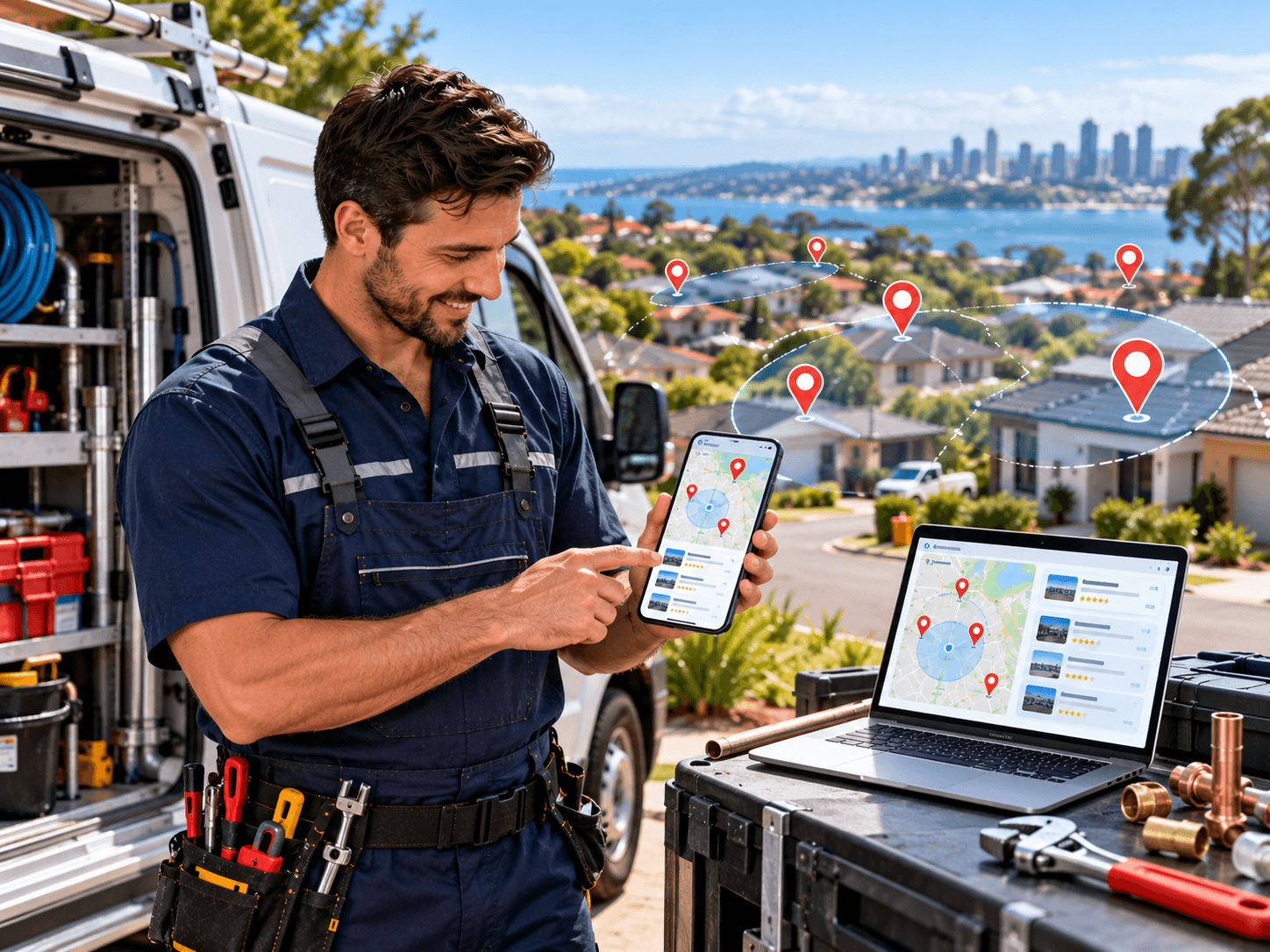
A plumber in Penrith lists thirty suburbs on his Google Business Profile, expecting calls from all of them. Instead, a competitor with fewer reviews keeps appearing in Maps for searches in a suburb he services every week. The listed suburbs didn’t do what he assumed, and nobody told him why.
That confusion is common, and it’s fixable. This guide explains how local SEO for plumbers actually works: how Google decides who to show, how to set up your Google Maps presence, how to build genuine service-area pages without creating spam, how to earn reviews properly, and how to measure whether it’s working. It’s written for owners and managers of Australian plumbing businesses, and the principles apply whether you work in Perth, Melbourne or a regional town.
Understanding the Problem: Why Plumbers Don’t Show Up Where They Work
Plumbers are service-area businesses. You travel to customers instead of waiting for them in a shop. Google’s local results were built around places customers visit, which makes service businesses harder to rank accurately. Typical symptoms:
- You appear in your home suburb but disappear a few suburbs away.
- A competitor with a worse website outranks you on Maps.
- Your profile shows up for “plumber” but not for “blocked drain” or “hot water repair”.
- Your phone rings from one area while another stays quiet.
- Your profile gets edited, suspended or flagged without explanation.
Behind most of these is a misunderstanding of what local search rewards. Once you know the three factors, the fixes become practical.
How Local Search Visibility Works
Google’s local results, the map block with three listings and the Maps app, rely on three main factors: relevance, distance and prominence. Google’s own help page on improving your local ranking describes them.
| Factor | What it means | What a plumber controls |
|---|---|---|
| Relevance | How well your profile matches what the searcher wants | Categories, services list, description, website content |
| Distance | How close you are to the searcher or the area they name | Your verified location and service areas (limited control) |
| Prominence | How well known and trusted you appear | Reviews, ratings, website quality, mentions and citations |
Two honest points follow from this.
Distance is the hardest factor to change. Listing a suburb as a service area tells customers and Google where you work, but several local SEO practitioners report that it acts as a soft hint, not a guarantee of appearing in that suburb. Hiding your address doesn’t help you rank further away either. So don’t expect a long list of suburbs to produce Maps visibility everywhere.
Relevance and prominence are where you can win. Choosing the right categories, publishing genuinely useful pages and earning a steady stream of real reviews all strengthen you across the whole area you serve.
If you’d like a second opinion on how your current profile and site perform, Rajhans Digital offers local SEO through our SEO and digital marketing services.
Local SEO for Plumbers on Google Maps: Your Business Profile
Your Google Business Profile is the foundation. Get it right before spending on anything else.
Business Name, Address and Contact Details
- Use your real business name. Don’t add keywords such as “Best Cheap Plumber Sydney 24/7”. It breaks Google’s guidelines for representing your business and risks suspension.
- Hide your address if you don’t serve customers at it. Service-area businesses without a shopfront should hide the address and show service areas instead.
- Use a real, consistent phone number and link to the most relevant page on your site, not always the homepage.
Categories and Services
- Choose “Plumber” as the primary category unless another is genuinely your main work. Categories are among the strongest relevance signals.
- Add secondary categories that match real services, such as gas fitter or drainage service, where they exist for your profession.
- Fill in the services list with specific offerings: blocked drains, hot water systems, leak detection, burst pipe repair, bathroom plumbing.
- Write a description in plain language about what you do and where, without stuffing in suburb names.
Service Areas
Google allows up to 20 service area entries, but you don’t have to fill them. List the areas you can realistically reach in a reasonable response time. Adding places you rarely work in dilutes the signal and sets customer expectations you can’t meet. Be aware that Google sometimes edits service areas automatically, so check your profile regularly.
Hours, Photos and Updates
- Set accurate hours. Only claim 24-hour availability if someone answers.
- Upload real photos of your vans, team and completed work. Update them regularly.
- Use profile posts for seasonal reminders, such as winter hot water failures or storm preparation.
- Respond promptly to calls and messages from the profile.
What Gets Profiles Suspended
Common triggers include virtual offices or fake shopfront addresses, keyword-stuffed names, duplicate listings, and creating separate profiles for suburbs where you have no genuine presence. Fake “satellite” listings are one of the fastest ways to lose your main profile.
Genuine Service-Area Pages
Your Business Profile helps you appear on Maps. Your website supports it by proving you serve each area and by capturing searches such as “plumber Joondalup” or “blocked drains Inner West”.
When a Service-Area Page Makes Sense
Create one when you genuinely work in that area and have something real to say about it. If you can’t write several honest paragraphs, or the page would differ from another only by the place name, don’t create it.
What a Good Service-Area Page Includes
- A clear headline with the service and area, such as “Plumbers Servicing Perth’s Northern Suburbs”.
- Suburbs you cover and your typical response approach.
- Local context: common issues you see there. Older homes with aging pipework, trees near drains, or areas with particular drainage challenges are examples, but only include what you’ve actually encountered.
- Real photos of jobs in the area, with customer permission.
- Reviews from customers in that area.
- Services available with links to your service pages.
- Licence number and insurance details, shown the way your state regulator requires.
- A phone number and a simple form.
- A few local questions answered.
Hub-and-Spoke Structure
Instead of forty near-identical suburb pages, group neighbouring suburbs by region. A Sydney plumber might build one page for the Inner West, one for the Northern Beaches and one for Western Sydney, each covering the suburbs within it. This keeps the site manageable and each page genuinely useful. Link them from a central “Areas We Service” page.
Weak vs Genuine: A Comparison
| Weak page | Genuine page | |
|---|---|---|
| Content | Same text with the suburb swapped | Written for that area |
| Photos | Generic stock | Real jobs and team |
| Reviews | None | From customers in the area |
| Purpose | Rank for a suburb | Help someone there decide |
| Risk | Treated as thin or doorway content | Supports local relevance |
Google’s spam policies warn against creating many near-duplicate pages aimed at different locations. Pages written for customers hold up better than pages written for search engines.
Customer Reviews
Reviews drive both rankings and decisions. They feed prominence, and a nervous customer often chooses the plumber with more recent, detailed reviews.
How to Earn Them Properly
- Ask every satisfied customer, ideally within a day of finishing the job.
- Send a direct review link by SMS or email, so it takes seconds.
- Make it part of your process. Add it to the invoice or the follow-up message.
- Reply to every review, thanking happy customers and responding calmly and factually to complaints.
- Don’t script or coach the wording. Customers who describe the problem and the suburb in their own words create natural relevance.
What Not to Do
- Don’t buy reviews, swap them or write your own.
- Don’t offer rewards for positive reviews, or ask only happy customers.
- Don’t ask staff or relatives to post them.
These practices breach Google’s policies, can lead to removal or suspension, and may mislead consumers under the Australian Consumer Law. The ACCC publishes guidance on online reviews. If you send review requests by SMS or email, keep them tied to the job just completed and check the Spam Act’s consent rules.
Citations, Mentions and Local Links
Prominence also depends on how widely your business is mentioned and trusted online.
- Directories. Make sure your name, address (or service area) and phone number are accurate and consistent on major Australian directories, Bing Places and Apple Business Connect.
- Trade associations. Membership of your state’s master plumbers association, if you hold it, can earn a legitimate profile listing and link.
- Local involvement. Sponsoring a junior sports club, a school event or a local charity can earn mentions on community websites.
- Suppliers and partners. Hardware suppliers, builders and real estate agencies you work with may list you.
Avoid paid link schemes and mass directory submissions. They add risk without adding trust.
Website Foundations That Support Local SEO
Your site should help Google understand who you are and where you work, while converting visitors:
- Fast, mobile-friendly pages. Check them against Google’s Core Web Vitals.
- Clear titles and headings that include the service and location naturally.
- LocalBusiness structured data that matches information visible on the page.
- Internal links between service pages and area pages.
- Your licence number and consistent contact details in the header or footer.
For how to convert the visitors that local search brings, see our guide to turning a plumbing site into a source of plumber website leads. For on-page basics, read our on-page SEO guide. Our website design and development services cover the build.
How to Measure Local SEO
| What to track | Where | What it tells you |
|---|---|---|
| Calls, website clicks, direction requests | Business Profile performance | How people use your listing |
| Search queries and pages | Google Search Console | Which searches and pages bring visitors |
| Calls and form submissions | Analytics and call tracking | Whether visibility becomes enquiries |
| Review count, rating and recency | Business Profile | Prominence and customer sentiment |
| Booked jobs by area | Your own records | Where marketing actually pays |
One warning: Maps rankings change depending on where the searcher stands. Checking from your office or your own phone tells you little. Use rank tracking that checks from several points across your service area, and judge results by calls and booked jobs, not by one screenshot.
A 90-Day Local SEO Plan
| Period | Focus | Actions |
|---|---|---|
| Days 1–14 | Foundation | Audit your profile: name, categories, hours, service areas, duplicates. Fix inconsistent listings. Start asking for reviews. |
| Days 15–45 | Website | Improve your top service pages. Build two or three genuine area pages for your busiest regions. Add structured data and fix speed. |
| Days 46–75 | Prominence | Complete directory and association listings. Add job photos. Keep the review flow steady. |
| Days 76–90 | Review | Compare calls and jobs by area. Extend what works, fix what doesn’t. |
Local visibility builds over months. Calls from improved conversion can arrive sooner than rankings.
Seven Costly Errors in Local SEO for Plumbers
- A keyword-stuffed business name. It breaks Google’s rules and risks suspension.
- Fake or virtual addresses in other suburbs. Google treats these as spam, and customers can tell.
- Cloned suburb pages. Dozens of near-identical pages add little value and risk problems with Google.
- The wrong primary category. It’s a strong relevance signal, so a wrong choice holds everything back.
- Ignoring reviews. No new reviews and no replies weaken prominence and trust.
- Inconsistent listings. Old numbers, old addresses and duplicate profiles confuse Google and customers.
- Checking rankings only from your own phone. Results vary by location, so you can’t judge visibility from one spot.
When Professional Help Makes Sense
Consider outside help when:
- Your profile has been suspended, duplicated or edited without explanation.
- You rank in one suburb but not others, and can’t tell why.
- Your website lacks the pages that support local search.
- You lack time to manage reviews, listings and content consistently.
- You want an honest assessment before you spend more.
Rajhans Digital provides local and technical SEO, website design and development, performance optimisation and analytics setup for service businesses internationally, working remotely with written scopes and clear reporting. Our services page lists the full range. To be clear about limits: we can’t answer your phones, collect reviews for you or attend jobs, and we won’t create fake listings or fake reviews. You’d give us access to your Business Profile as a manager, keep ownership of every account, and supply real photos and licence details.
How to Choose a Local SEO Partner for a Trades Business
- They explain their suburb-page approach. Look for genuine regional pages, not hundreds of clones.
- They refuse fake addresses and fake reviews.
- They don’t guarantee rankings or Maps positions.
- You own your profile, analytics and domain, and they use manager access.
- They report on calls and booked jobs, not just rankings.
- They can show real examples and offer references.
- Contract terms are clear, with no lock-in.
Frequently Asked Questions
Do I need a physical shopfront to appear on Google Maps?
No. Service-area businesses can have a verified profile with a hidden address and defined service areas. Be sure to follow Google’s verification and address rules, and never use a fake address.
How many suburbs should I list as service areas?
Only places you can realistically reach in a reasonable time. Google allows up to 20, but you needn’t use them all. A shorter, accurate list sets better expectations than a long one.
Do I need a separate page for every suburb?
No. Group nearby suburbs into genuine regional pages, and add more detail only where you have real local content to share. Many near-identical suburb pages can do more harm than good.
How many reviews do I need to rank?
There’s no fixed number. Rankings depend on your competitors in your area. Aim for steady, recent, genuine reviews with sensible replies.
How long does local SEO take?
Profile fixes can have effects within weeks, while stronger visibility often takes months. It depends on competition and your starting point. Nobody can guarantee a position.
Can I rank in suburbs far from my base?
It’s harder, because distance still matters, and listing an area doesn’t guarantee visibility there. Focus on the areas you serve well, build relevance and reviews, and let work in nearby areas strengthen your presence over time.
Conclusion
Local SEO for plumbers comes down to a few honest habits: a complete, accurate Google Business Profile, genuine pages for the areas you serve, a steady flow of real reviews, consistent listings and a fast website that turns visibility into calls. Skip the shortcuts, such as fake addresses, cloned pages and bought reviews, because they put your whole profile at risk. Start with the profile audit, then build from there.
Talk to Rajhans Digital About Your Local SEO
If your plumbing business isn’t showing up where you work, Rajhans Digital can review your Google Business Profile, website and local presence and recommend practical priorities. We’ll explain what to fix first and why, without pressure or inflated promises.
Request a local SEO review or contact Rajhans Digital to discuss your business.