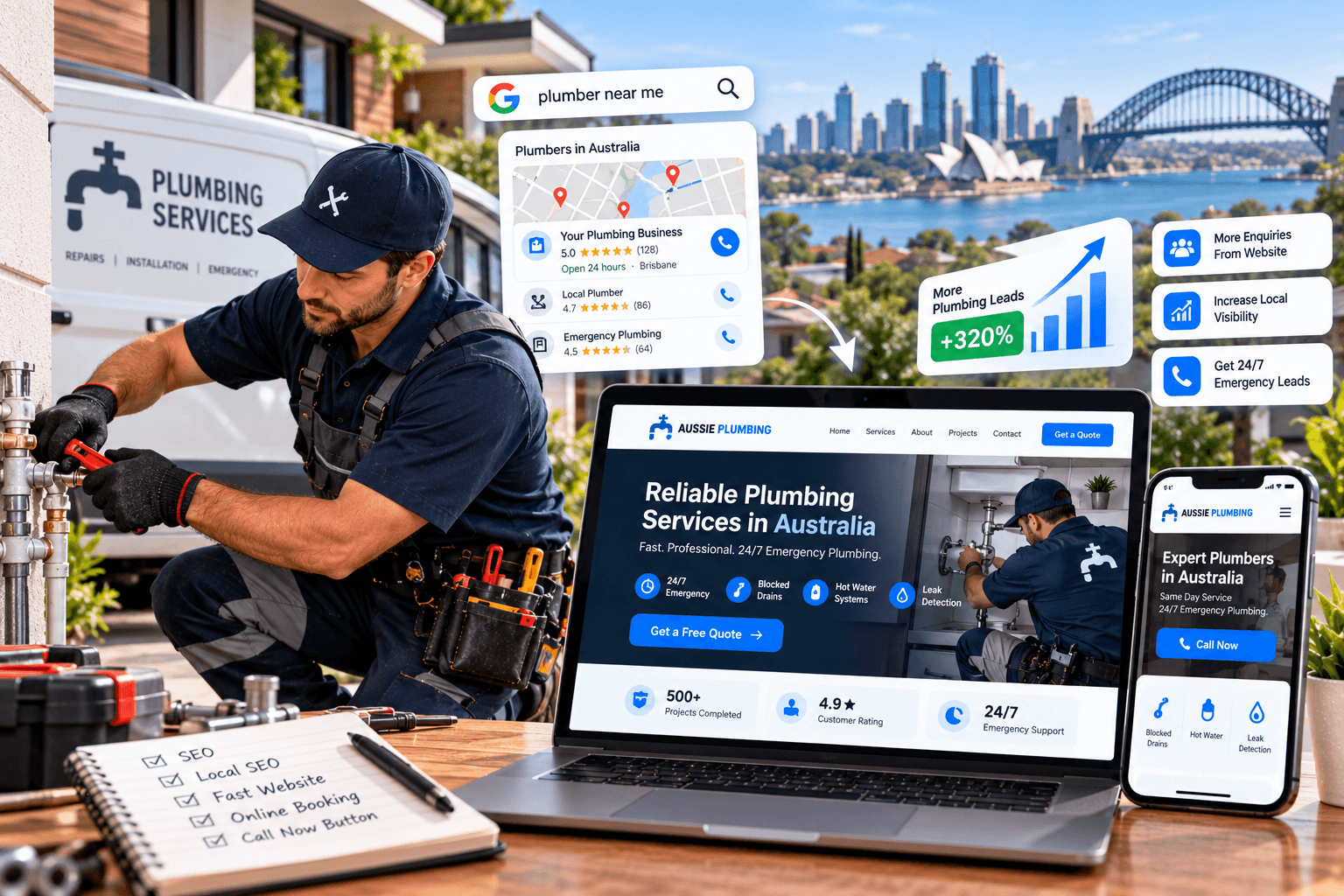
A plumber in Adelaide pays for a new website, and six months later the phone is no busier. The site is attractive. It has a gallery, an “About Us” page and a contact form. But visitors arrive, look around for a few seconds, and leave without calling anyone.
This is the most common problem with plumber website leads: traffic isn’t the issue, conversion is. This guide explains how a plumbing website turns visitors into calls and quote requests, covering conversion-focused design, mobile use, contact forms, reviews, service pages and local SEO. It’s written for owners and managers of plumbing businesses anywhere in Australia, and it applies whether you handle emergency call-outs, hot water replacements or bathroom renovations.
Understanding the Problem: Why Plumbing Websites Don’t Convert
Most plumbing websites fail in one of five ways:
- Visitors can’t tell what you do or where you work within a few seconds.
- The phone number is hard to tap or find, especially on mobile.
- There’s no evidence of trust: no licence number, no real reviews, no photos of actual work.
- Service information is thin, so someone searching for “blocked drain repair” lands on a vague “Services” page.
- Nobody measures it, so nobody knows whether the site is working.
A plumbing customer is usually in one of two states: urgent (a burst pipe, no hot water) or planning (a bathroom renovation, a hot water upgrade). Urgent visitors want a phone number and reassurance. Planning visitors want proof, detail and a way to request a quote. A good site serves both without confusing either.
What Drives Plumber Website Leads
Think of lead generation as a chain with four links:
- Visibility: people can find your site, through Google Maps, search results or ads.
- First impression: the page loads quickly and says clearly what you do and where.
- Trust: the page proves you’re licensed, reviewed and reliable.
- Action: calling or enquiring is obvious and easy.
A weak link anywhere reduces the total. Many plumbers spend on visibility while the other three links leak enquiries. Here’s a quick illustration with arithmetic, not a benchmark: if 1,000 people visit your site each month and 2% enquire, you get 20 leads. If better design and trust signals lift that to 4%, the same traffic produces 40 leads. Improving conversion often costs less than doubling traffic.
If you’d like an independent look at where your site loses visitors, Rajhans Digital offers website design and development services built around conversion.
Conversion-Focused Design for Plumbing Websites
The Homepage Should Do Six Jobs
From top to bottom, a lead-generating plumbing homepage typically includes:
- A clear headline: what you do and where, such as “Licensed plumbers servicing Perth’s northern suburbs”.
- A visible phone number and call button in the header.
- A short list of core services, each linking to its own page.
- Trust evidence: licence number, insurance, years in business, review rating and a few genuine reviews.
- Photos of your real team and work, not generic stock images.
- A simple next step: call, request a quote, or book.
Design for Decisions, Not Decoration
Keep the layout clean, with generous spacing and readable text. Use one clear call to action per section. Avoid sliders, auto-playing video and pop-ups that cover the phone number. Use real photos of your vans, uniform and finished jobs. Generic images of smiling stock plumbers reduce trust because customers can tell.
Mobile-Friendly Websites: Where Most Plumber Website Leads Are Won or Lost
Most plumbing searches happen on phones, often with urgency. Google also indexes the mobile version of a site first, so how your site works on mobile affects both visitors and search visibility. Google explains this in its guidance on mobile-first indexing.
Check these on a real phone, not just a desktop browser:
- A tap-to-call button that stays visible as visitors scroll.
- Text-based phone numbers, not numbers inside images.
- Fast loading. Test with Google’s Core Web Vitals tools and compress oversized images.
- Buttons large enough to tap without zooming.
- Short forms that work with a phone keyboard.
- No intrusive pop-ups that block content.
Contact Forms That Get Completed
Calls matter most for urgent work, but forms capture planning customers, after-hours enquiries and people who don’t want to phone. A good plumbing contact form:
- Asks for little: name, phone number, suburb and a short description of the job. Every extra field reduces completions.
- Offers a phone alternative next to the form: “Prefer to call? Tap here.”
- Sets expectations: “We reply within one business hour” is only worth saying if you do.
- Sends instant notifications to a phone or email that someone actually checks.
- Confirms submission with a clear thank-you message.
- Uses spam protection that doesn’t make real customers solve puzzles.
- Explains privacy in a short line linking to your privacy policy.
Then follow up quickly. A form enquiry answered in minutes is far more likely to become a job than one answered the next day. If you send SMS or email marketing afterwards, check the Spam Act’s consent rules.
Reviews and Trust Signals
Customers hiring someone to enter their home look for proof. Show it prominently.
- Licence number. Licensing is state-based, and several states require it in advertising. NSW requires the licensee’s name and licence number in all advertising, and Queensland’s regulator, the QBCC, requires the number on plumbing advertising regardless of job value. Rules in other states differ, so check with your regulator. See the NSW advertising rules and the QBCC advertising page. A footer on every page is a simple place for it.
- Insurance and compliance. Mention public liability insurance and that you provide the compliance paperwork your state requires.
- Real reviews. Show Google reviews on your site, with permission to use names and suburbs. Rotate them so they stay current.
- Photos of finished work with short descriptions of the problem and fix.
- Your team. A real photo and a few lines about who will arrive builds confidence.
- Clear pricing information. Explain call-out fees, what they cover, and how quotes work.
Never post fake or incentivised reviews without disclosure. They can mislead consumers and breach the Australian Consumer Law, and they damage trust if discovered. The ACCC publishes guidance on online reviews.
Service Pages That Capture Searches
A single “Services” page rarely ranks or converts. Customers search for specific problems: “hot water system replacement”, “blocked drain”, “gas fitter”, “leak detection”. Give each core service its own page, built to a consistent template:
| Section | What to include |
|---|---|
| Headline | The service and area, such as “Hot Water System Replacement in Adelaide” |
| Opening | A plain description of the problem and how you solve it |
| What’s included | Brands, work types, typical process |
| When to call | Signs the problem needs a licensed plumber |
| Trust | Licence number, relevant reviews, photos |
| Pricing guidance | What affects the cost, without making unrealistic promises |
| FAQs | Real customer questions |
| Call to action | Phone and form |
Write these pages in your own words, from real jobs. Copying generic text from other plumbers makes your site forgettable and gives Google no reason to prefer you.
Local SEO for Plumber Website Leads
Local SEO helps nearby customers find you when they search. Your website works together with your Google Business Profile.
- Complete your Google Business Profile with accurate hours, categories, service areas and photos, and link it to the right page on your site.
- Keep your name, address and phone number consistent across your site and listings.
- Build genuine area pages for places you really serve, with unique detail about the area, typical issues, and local reviews. Don’t create dozens of near-identical suburb pages, which Google’s spam policies treat as a problem.
- Add structured data. LocalBusiness markup helps search engines understand your business, but only mark up information visible on the page.
- Write clear titles and headings that include the service and location naturally.
- Link between pages so visitors and search engines can navigate your services.
- Improve speed and mobile experience, which feed into both rankings and conversion.
Nobody can guarantee a ranking, but a technically sound site with strong local signals gives you the best chance. Our SEO services and on-page SEO guide explain the foundations in more detail.
Tracking: Know Where Your Leads Come From
Set up three simple measurements:
- Calls and taps on your phone number, tracked as events in Google Analytics
- Form submissions, tracked as conversions
- Search queries and pages, through Google Search Console
Then keep a simple weekly record: calls received, calls answered, jobs booked and where each came from. Without it, you can’t tell whether a redesign, an ad or a new page worked.
A 30-Day Improvement Plan
| Week | Focus | Actions |
|---|---|---|
| 1 | Quick fixes | Add a tap-to-call button, show your licence number, fix slow images, check forms deliver properly |
| 2 | Trust | Add real reviews, team and work photos, insurance and compliance details |
| 3 | Service pages | Write or rewrite your top three service pages |
| 4 | Tracking and review | Set up call and form tracking, then review the first results |
Seven Costly Mistakes That Reduce Plumber Website Leads
- A hard-to-find phone number. Burying it in a menu or an image costs calls.
- Stock photos and vague claims. Customers trust real people and real work.
- One page for all services. It rarely ranks or answers specific needs.
- Long forms. Every extra question reduces completions.
- Slow mobile loading. Heavy images and scripts drive visitors away.
- Missing licence details. It risks breaching advertising rules and weakens trust.
- No tracking. If you can’t see what works, you can’t improve it.
When Professional Help Makes Sense
Consider outside help when your site is outdated, hard to update, or slow; when enquiries are low despite steady traffic; when you spend on ads without tracking results; or when you lack the time to write service pages and manage local SEO.
Rajhans Digital provides website design and development, WordPress builds, local and technical SEO, performance optimisation and analytics setup for service businesses internationally, working remotely with written scopes and regular reporting. To be clear about limits: we work from India, so we can’t answer your phones, photograph your team on site or handle licence paperwork. You’d supply real photos, licence details and reviews, and we’d build and measure the website. Depending on your city and daylight saving, Australian cities are roughly 2.5 to 5.5 hours ahead of India, so working hours overlap well. See our services page for more.
How to Choose a Website Partner for a Plumbing Business
- They ask about your work first: services, areas, margins and how you handle calls.
- They don’t guarantee rankings or a fixed number of leads.
- You own everything: domain, hosting, Google Business Profile and analytics.
- They show real examples and offer verifiable references.
- They don’t mass-produce suburb pages or buy fake reviews.
- They report on calls and enquiries, not only traffic and rankings.
- Contract terms are clear, with no lock-in that holds your site hostage.
Frequently Asked Questions
What makes a plumber’s website generate more leads?
A fast mobile site with a visible phone number, clear service pages, real reviews, your licence details and a simple contact form. Tracking calls and forms lets you improve over time.
How many pages should a plumbing website have?
Enough to cover your main services and areas, each with useful, original content. Quality matters more than quantity. A well-built ten-page site usually beats a hundred thin ones.
Do I need a contact form if people can call?
Yes. Forms capture after-hours enquiries and customers who prefer not to phone. Keep them short and respond quickly.
Should I show my licence number on my website?
Several Australian states require licence details in advertising, and showing them also builds trust. Check your state regulator’s rules, and put the number where visitors can see it, such as the header or footer.
How long does it take to see results?
Improvements to design and conversion can show up within weeks as visitors start calling more. Search visibility usually takes longer. Nobody can guarantee a ranking or timeline.
Can an overseas agency build my plumbing website?
Yes, for design, development, SEO and tracking, as long as you own the accounts, agree the scope in writing, and supply real photos, licence information and reviews. They can’t answer your phones or attend jobs.
Conclusion
Plumber website leads come from a chain of small decisions: a clear first impression, an obvious way to call, real proof of trust, specific service pages and sound local SEO. Fix the weakest link first, track results, and build from there. A website that clearly answers a customer’s questions and makes contact easy will do more for your business than a more expensive one that doesn’t.
Talk to Rajhans Digital About Your Plumbing Website
If your website gets visitors but few calls, Rajhans Digital can review it and recommend practical improvements to design, content, tracking and local SEO. We’ll explain what to fix first and why, without pressure or inflated promises.
Request a website review or contact Rajhans Digital to discuss your project.